Video Games & Film · Historical dossier

The unreleased projectSusanoo

素戔鳴 · スサノオ

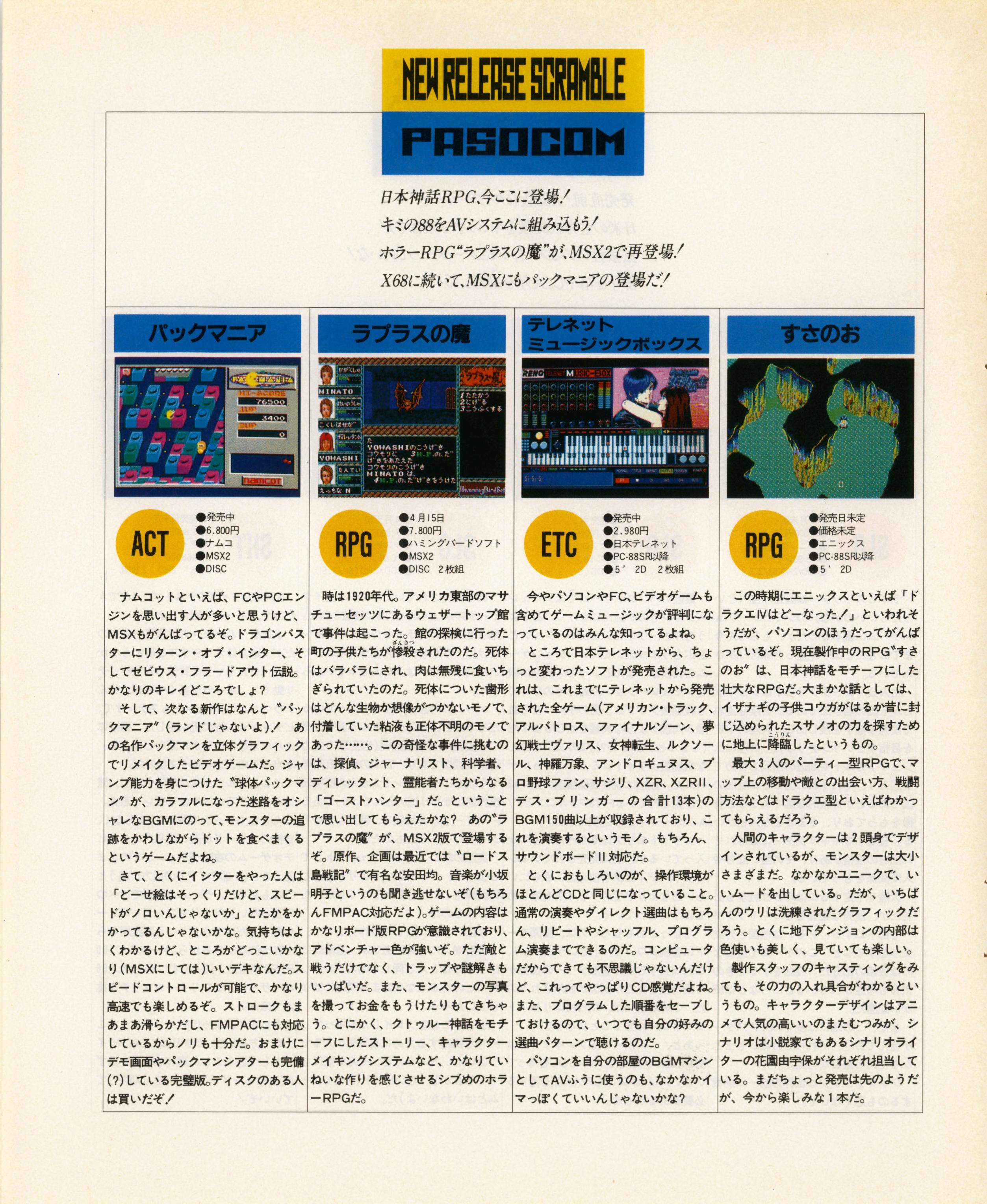
A prince driven from the realm of the gods, an adventure without experience points and a world illustrated by Mutsumi Inomata. The archives of 1989 and Mitsuhiro Arita’s testimony trace the ambitions of an Enix RPG that remained unreleased.

Enix1989PC-9801Mutsumi InomataMitsuhiro Arita

Arita’s role

Alongside Mutsumi Inomata

Arita describes work on maps, characters and the development of an editor. As Inomata’s assistant, he also created atmospheric illustrations for the game’s maps.

Susanoo belongs to a period when drawing and programming still intersected in his career. An encounter during this work would contribute to his decision to pursue illustration.

Read testimony ↓

Susanoo · 1989

A mythological RPG from Enix

Susanoo — document from the collection 02
Document 02 · Enlarge ↗

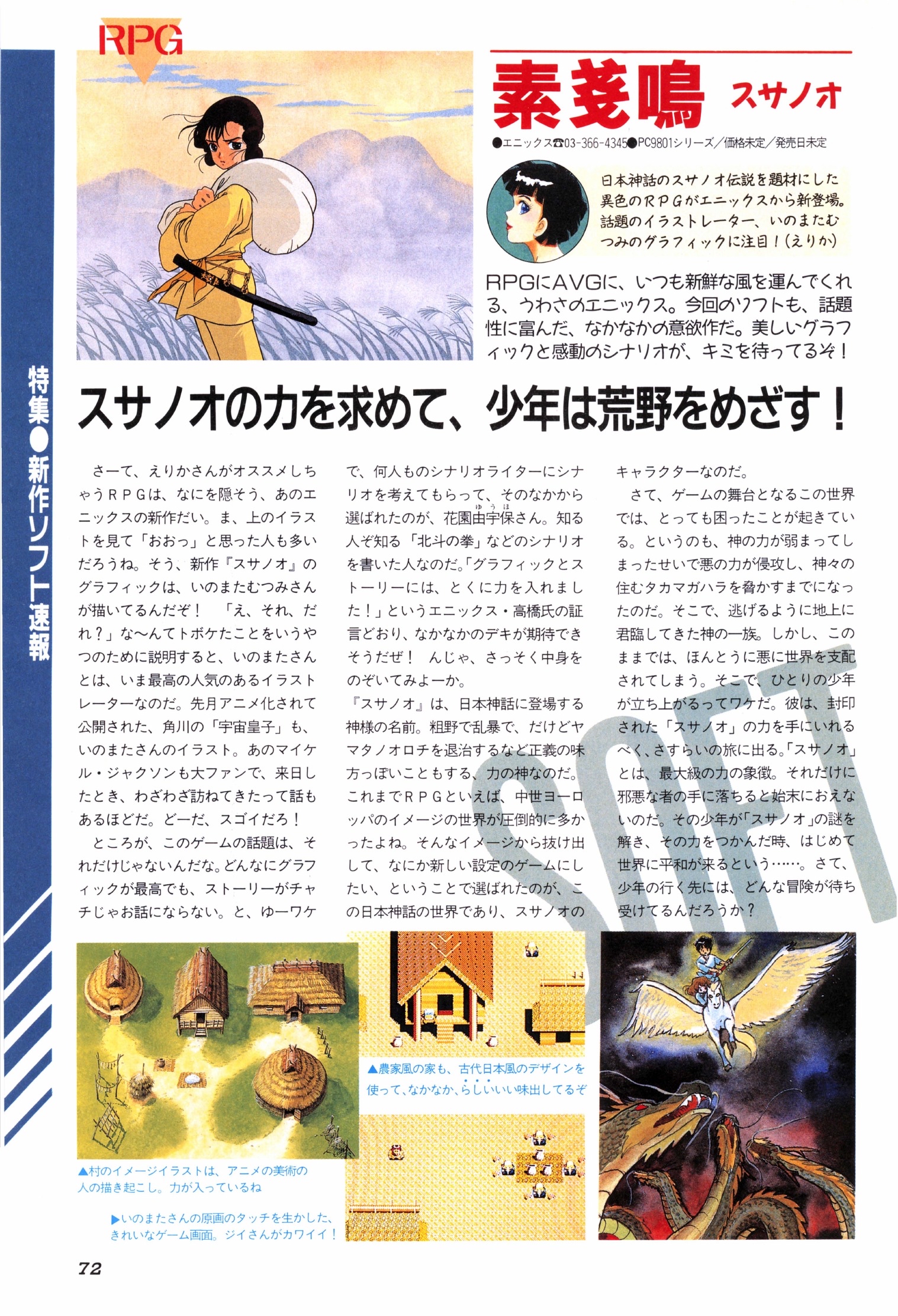
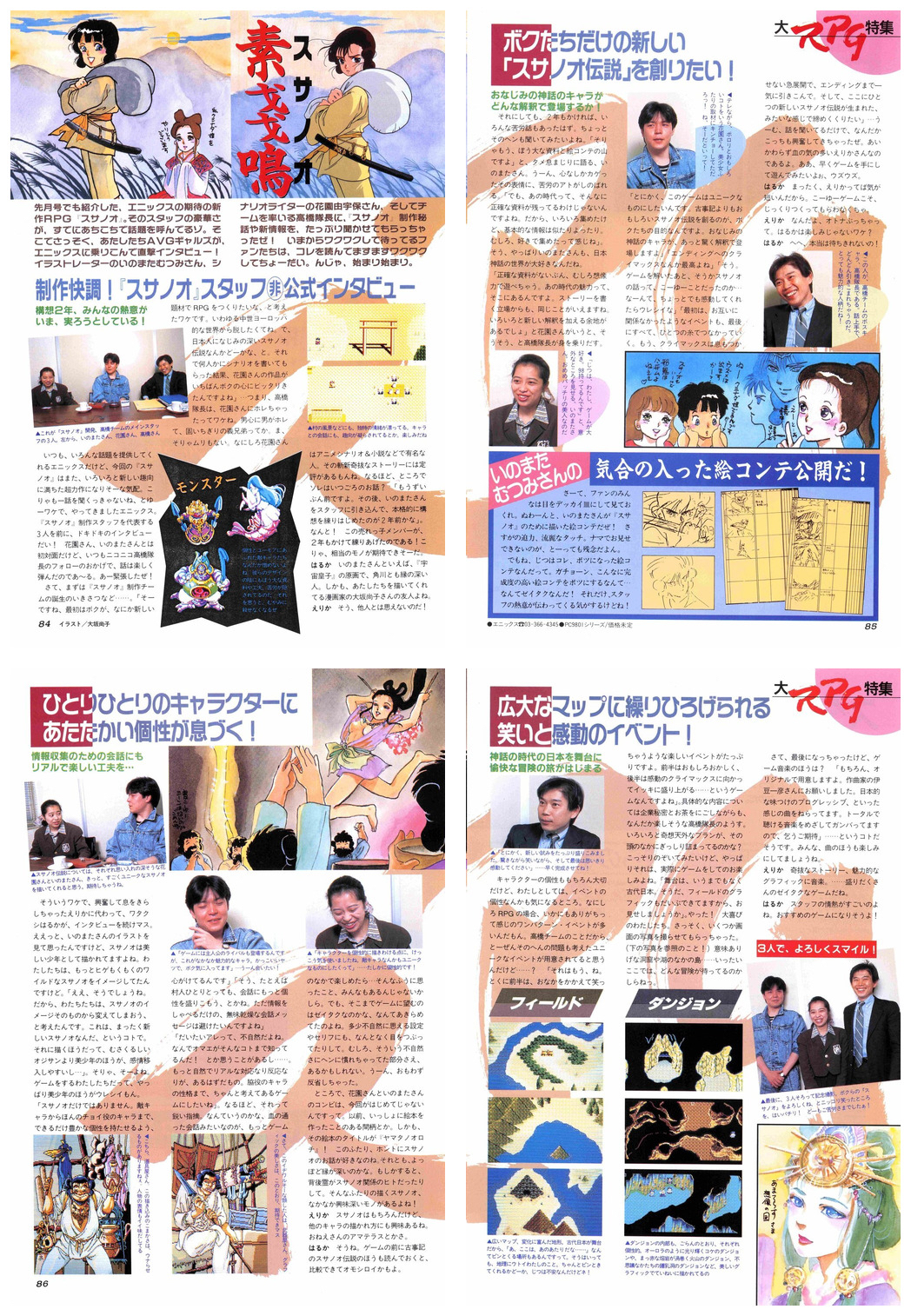
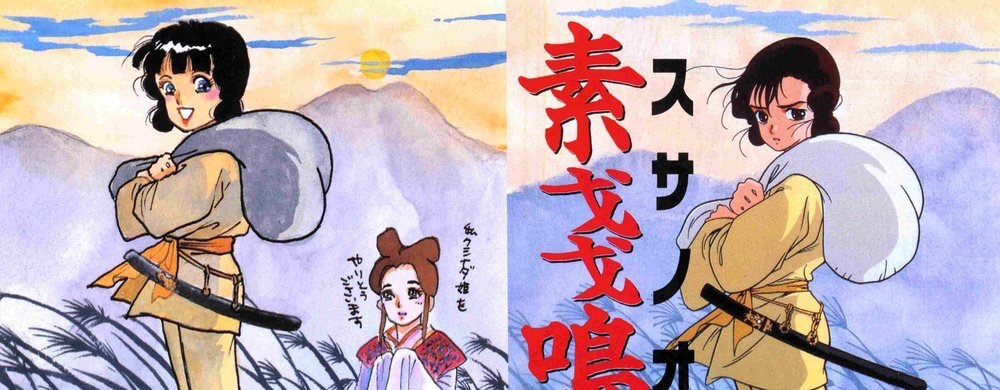
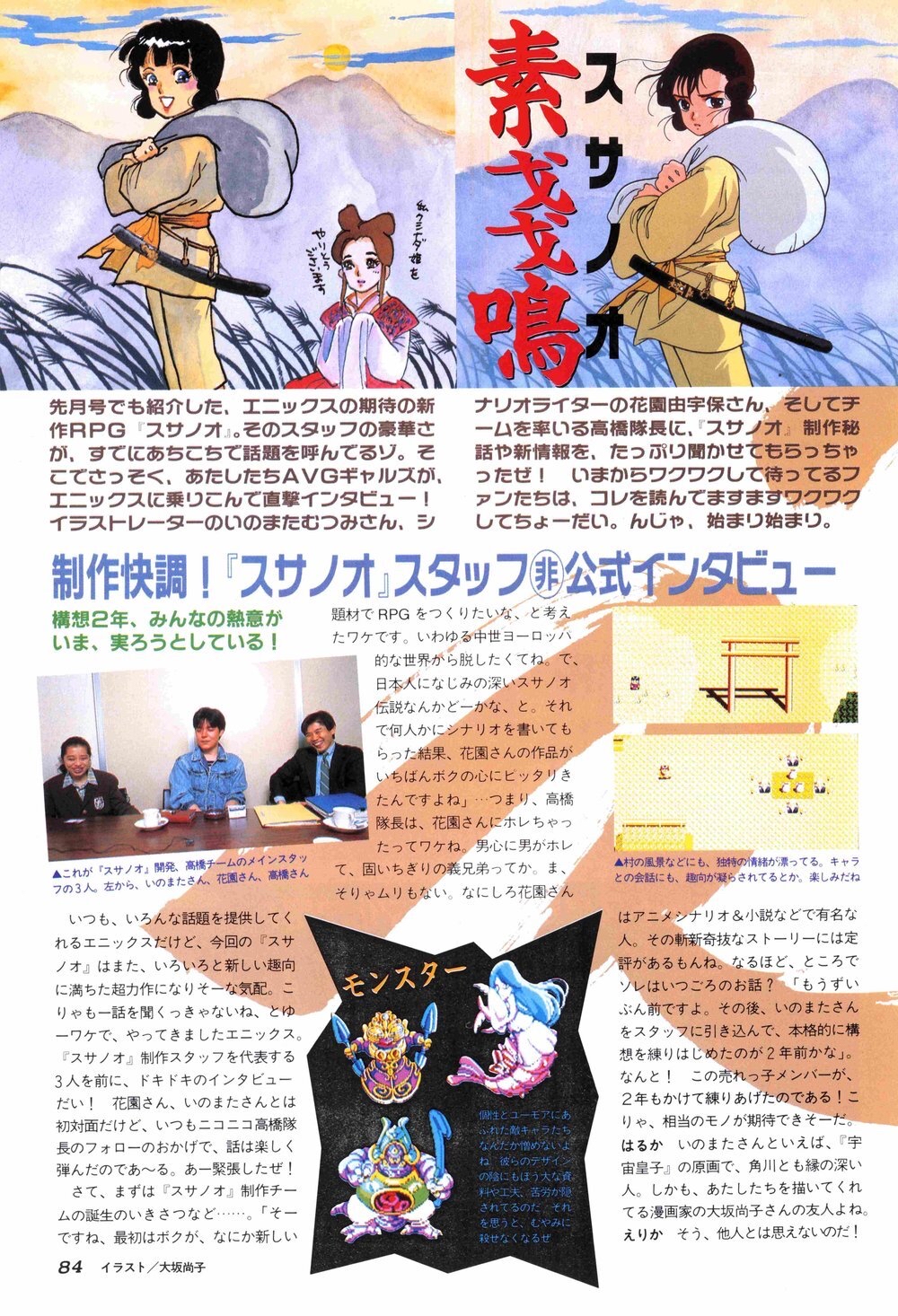
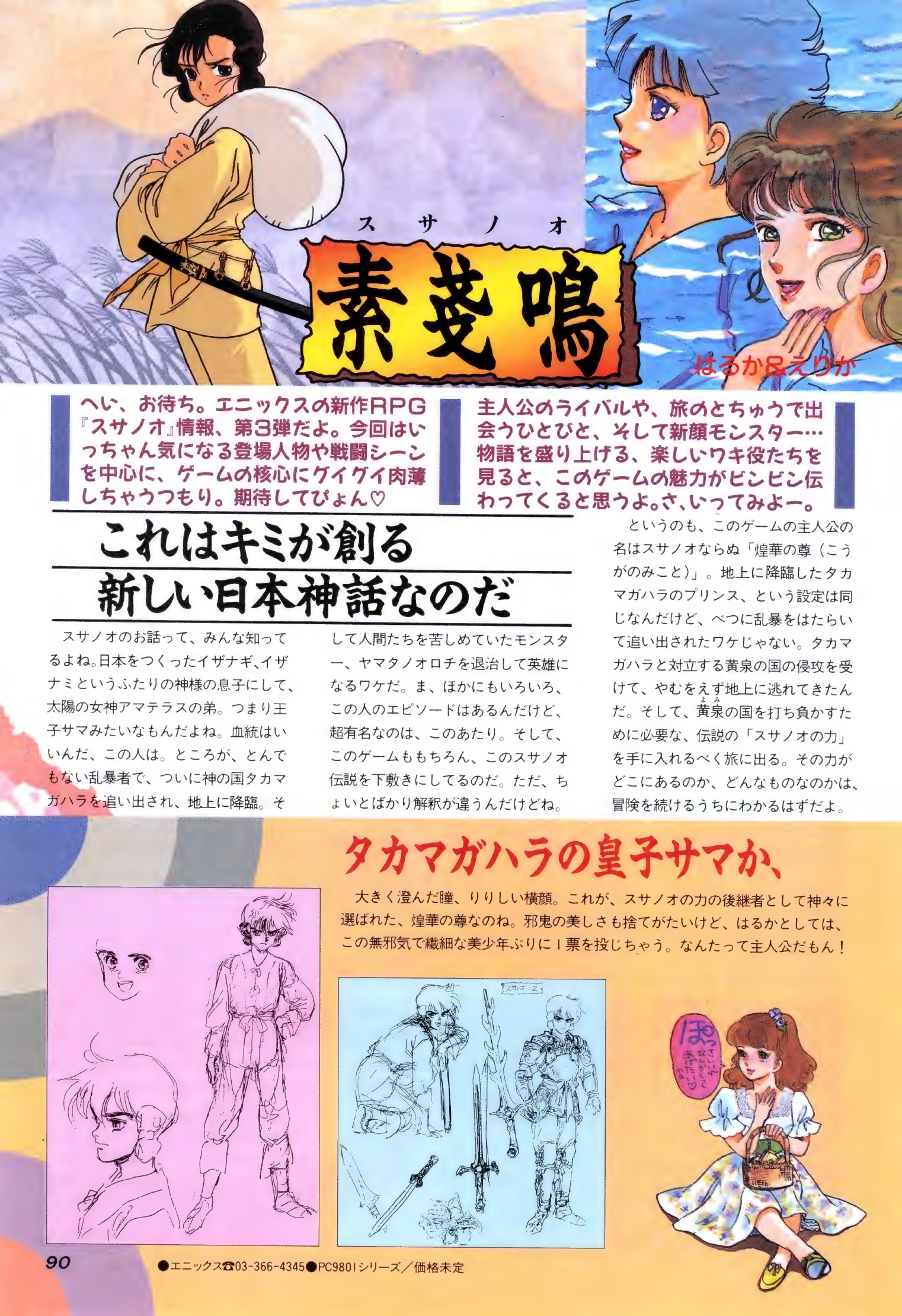
Susanoo, presented under the Japanese title 素戔鳴 with the reading スサノオ, is an Enix role-playing game project documented in the Japanese press of 1989. It turns the gods, places and creatures of Japanese mythology into an original adventure. The articles show a world of ancient villages, shrines, caves and supernatural lands, rather than the castles and knights of European medieval fantasy.

Susanoo — document from the collection 03
Document 03 · Enlarge ↗

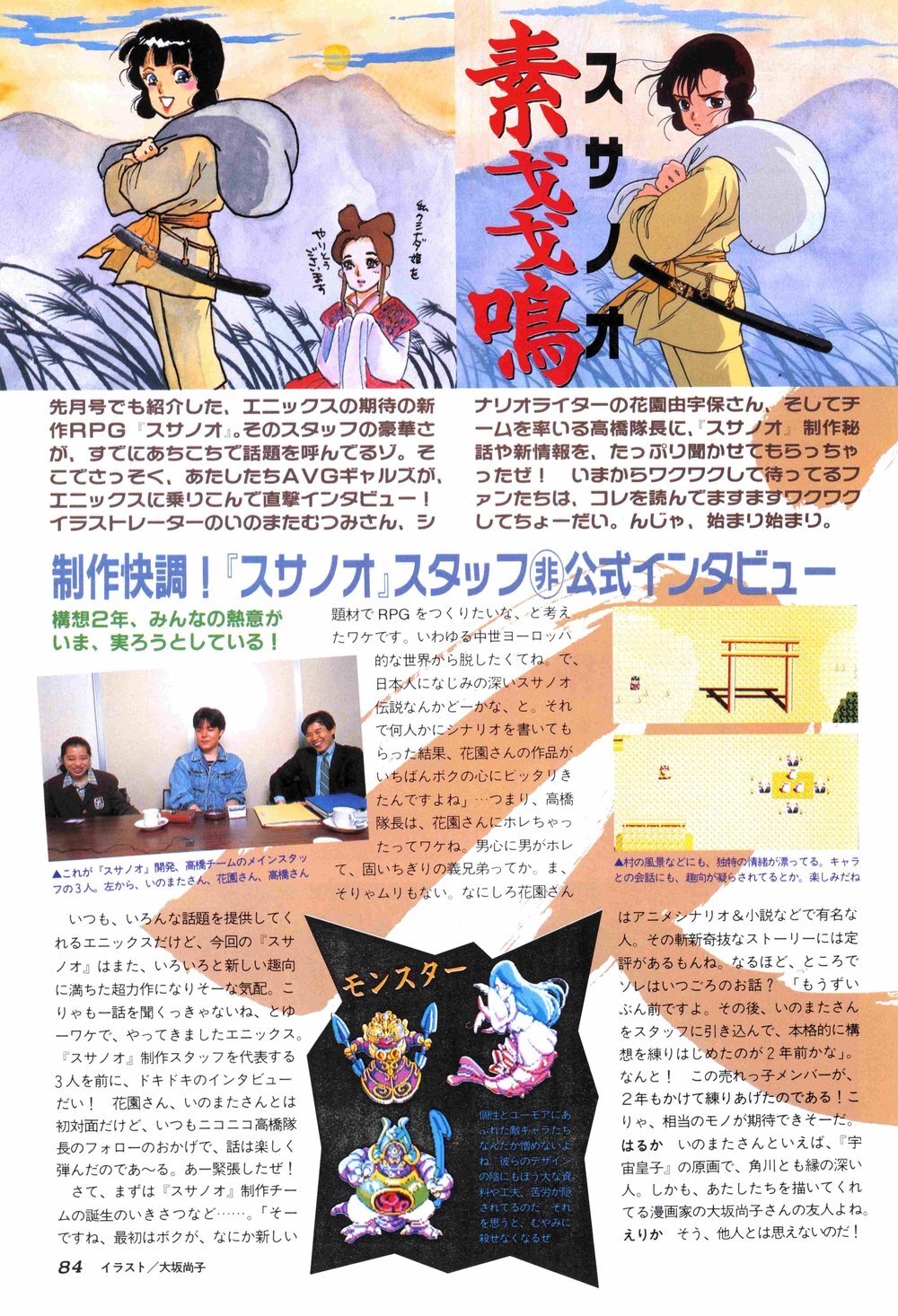
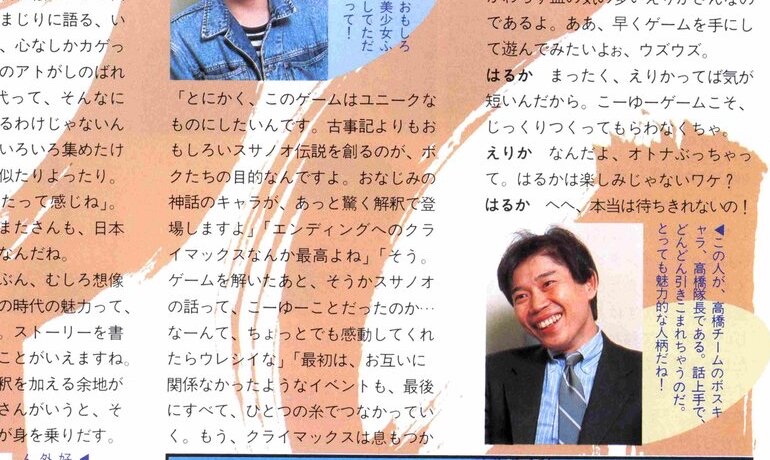
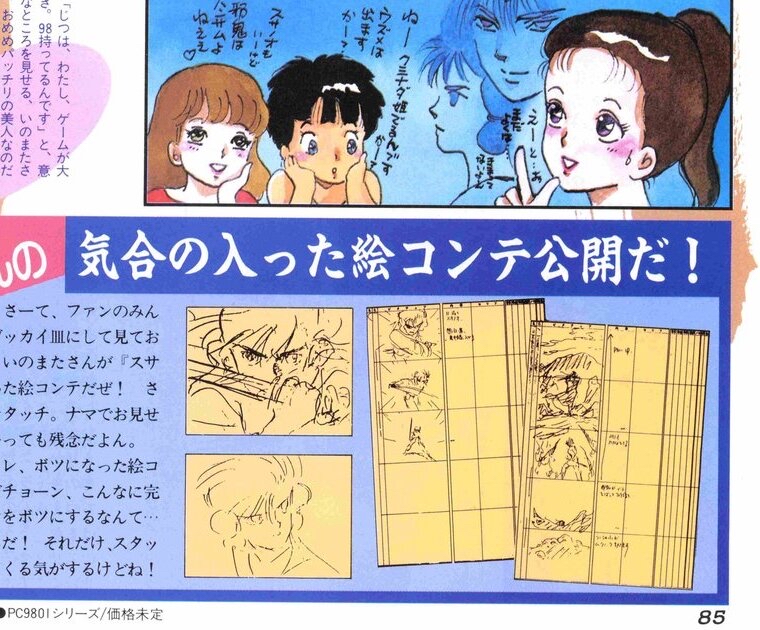
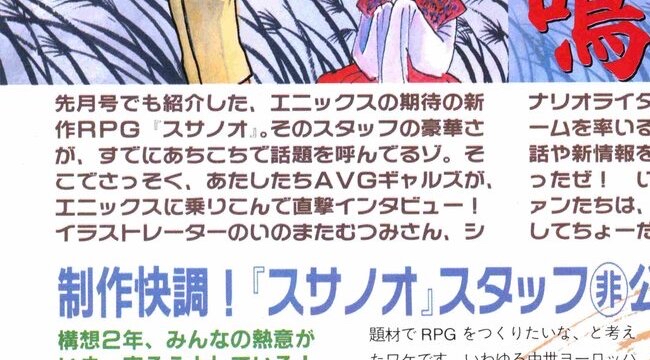
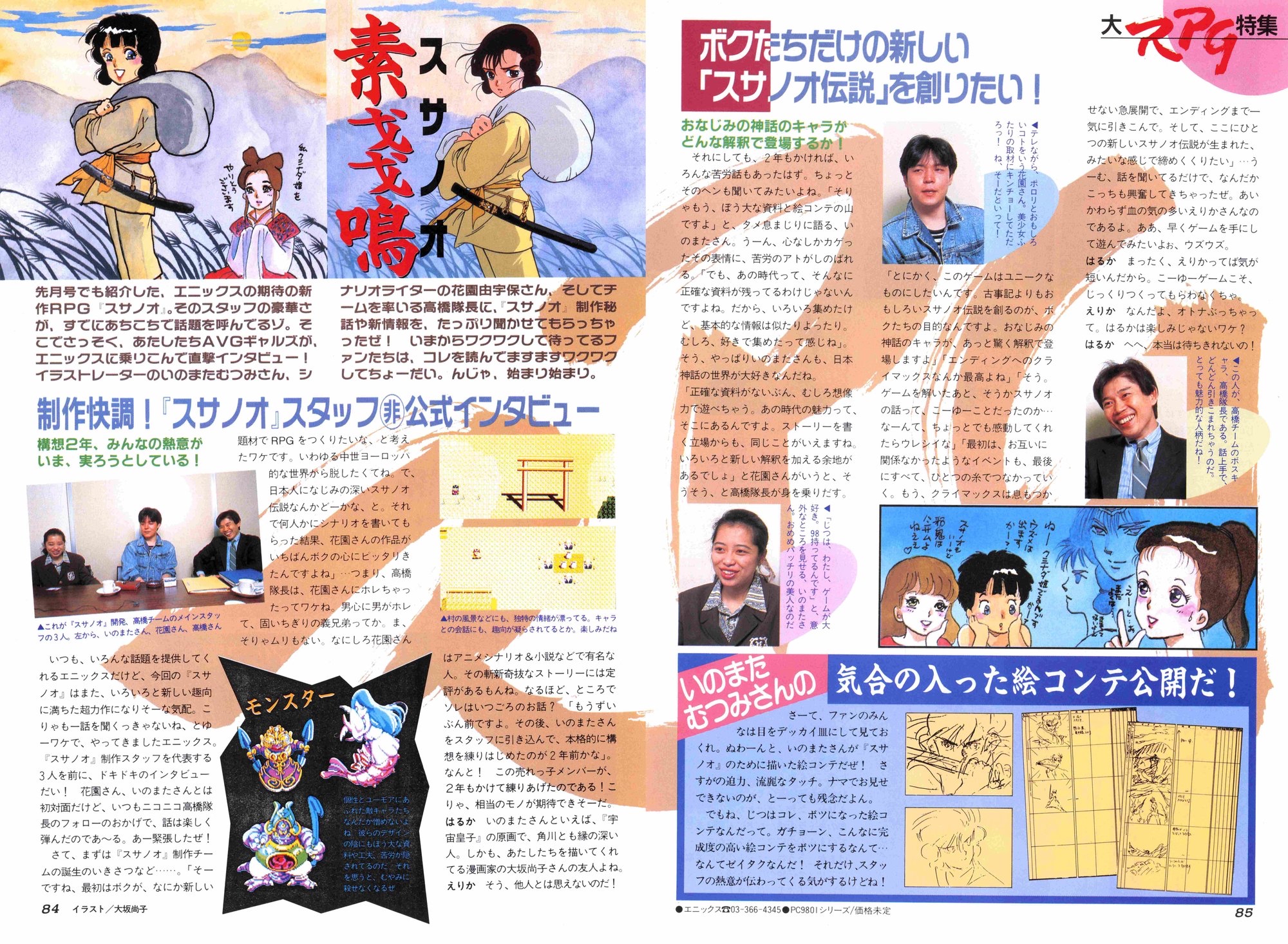
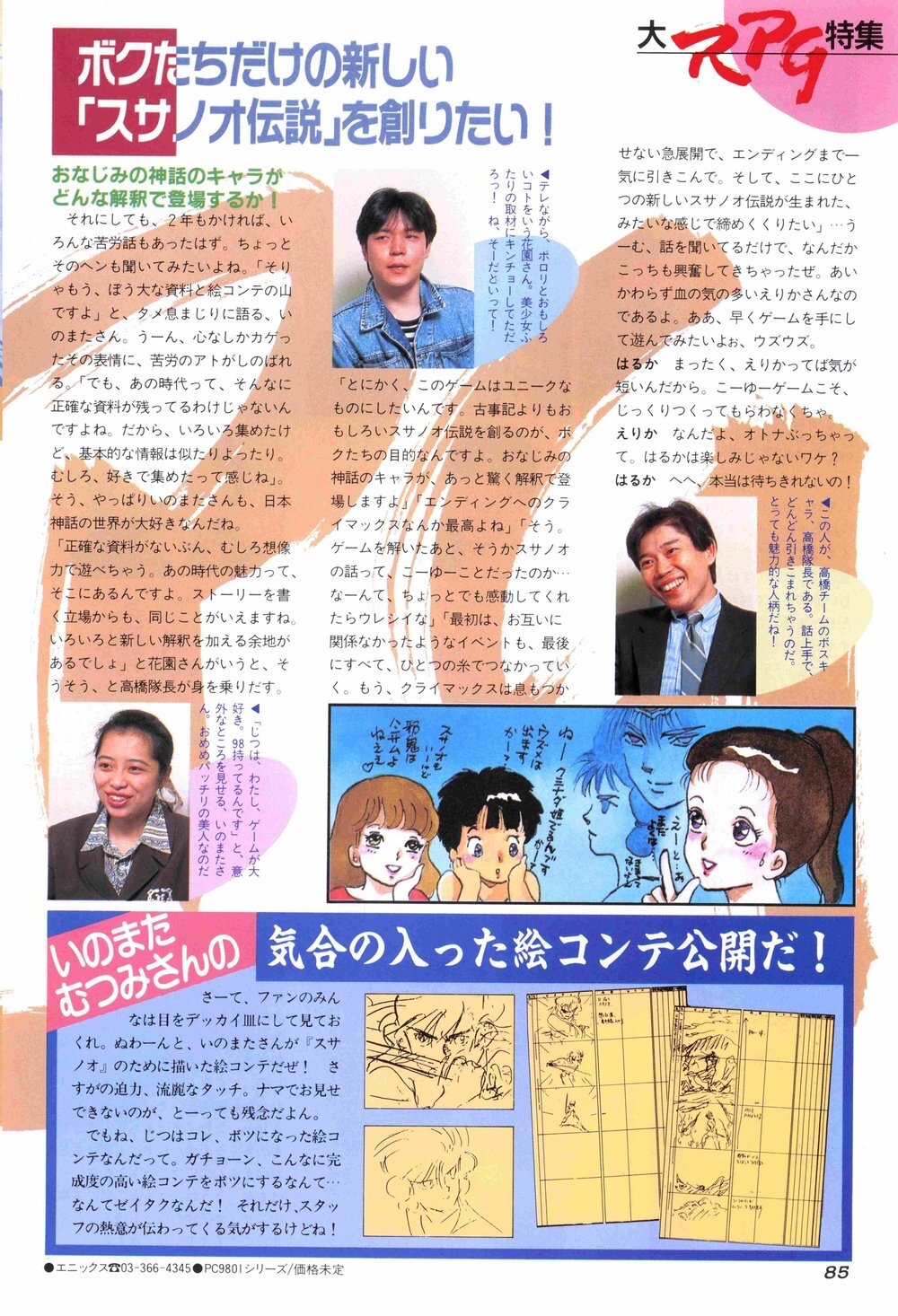
The May presentation emphasises two ambitions: graphics and story. The Enix representative named Takahashi explains that several writers proposed scenarios before Yūho Hanazono’s was selected. Mutsumi Inomata’s illustrations are another central feature. The magazine pages combine preparatory drawings, characters, environments and game screenshots to show how this world was intended to take shape on screen.

Susanoo — document from the collection 04
Document 04 · Enlarge ↗

Comptiq announces the PC-9801, while POPCOM uses the broader designation PC-9800 Series. The battles described use commands, weapons and ritual powers. It is therefore more accurate to describe Susanoo as a mythological RPG than to assume that it played as an action game.

Comptiq · 1989-05 · pp. 72–73 ; Comptiq · 1989-07 · pp. 90–93

Susanoo · 1989

Kōga, prince of an invaded realm

Susanoo — document from the collection 05
Document 05 · Enlarge ↗

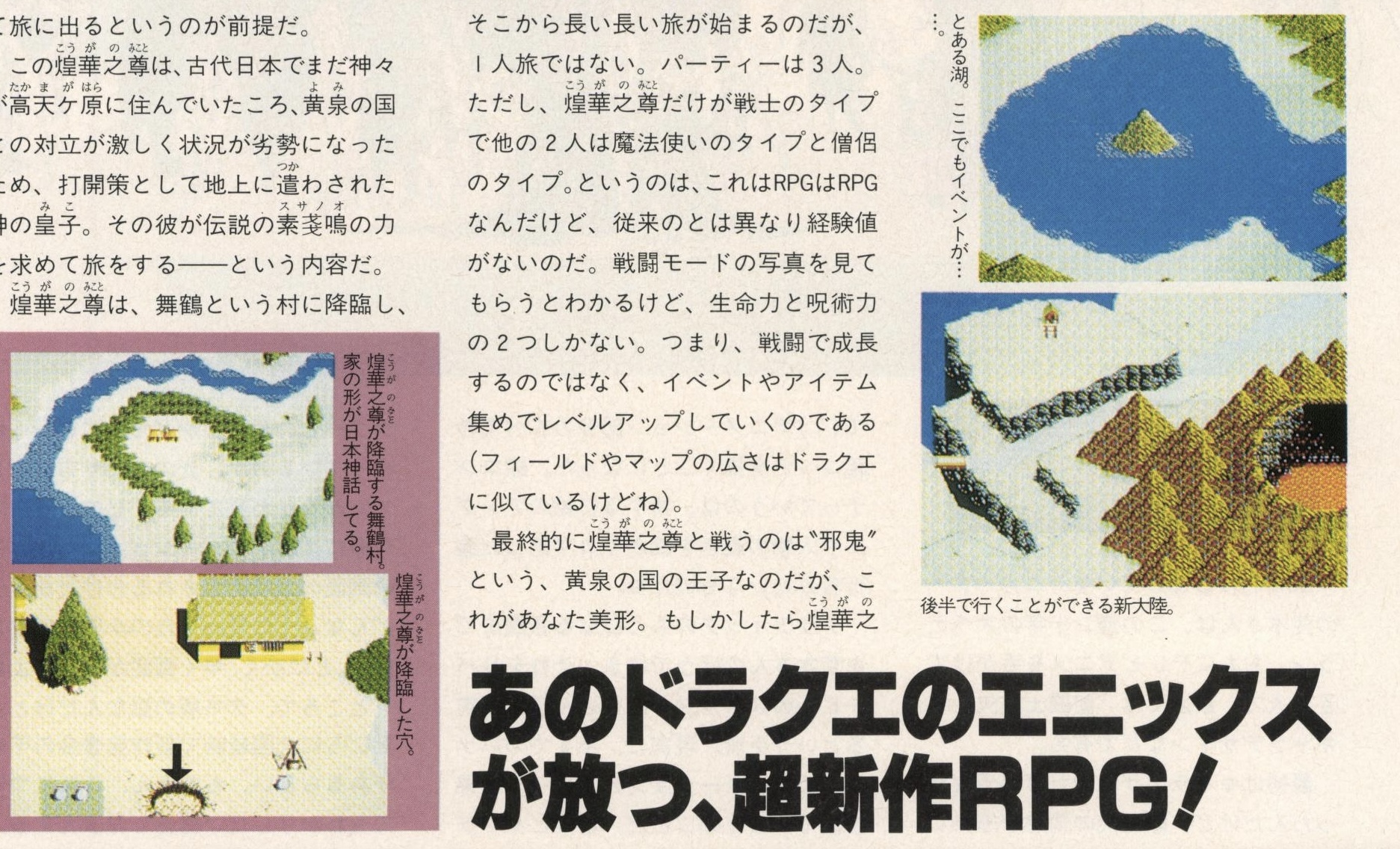
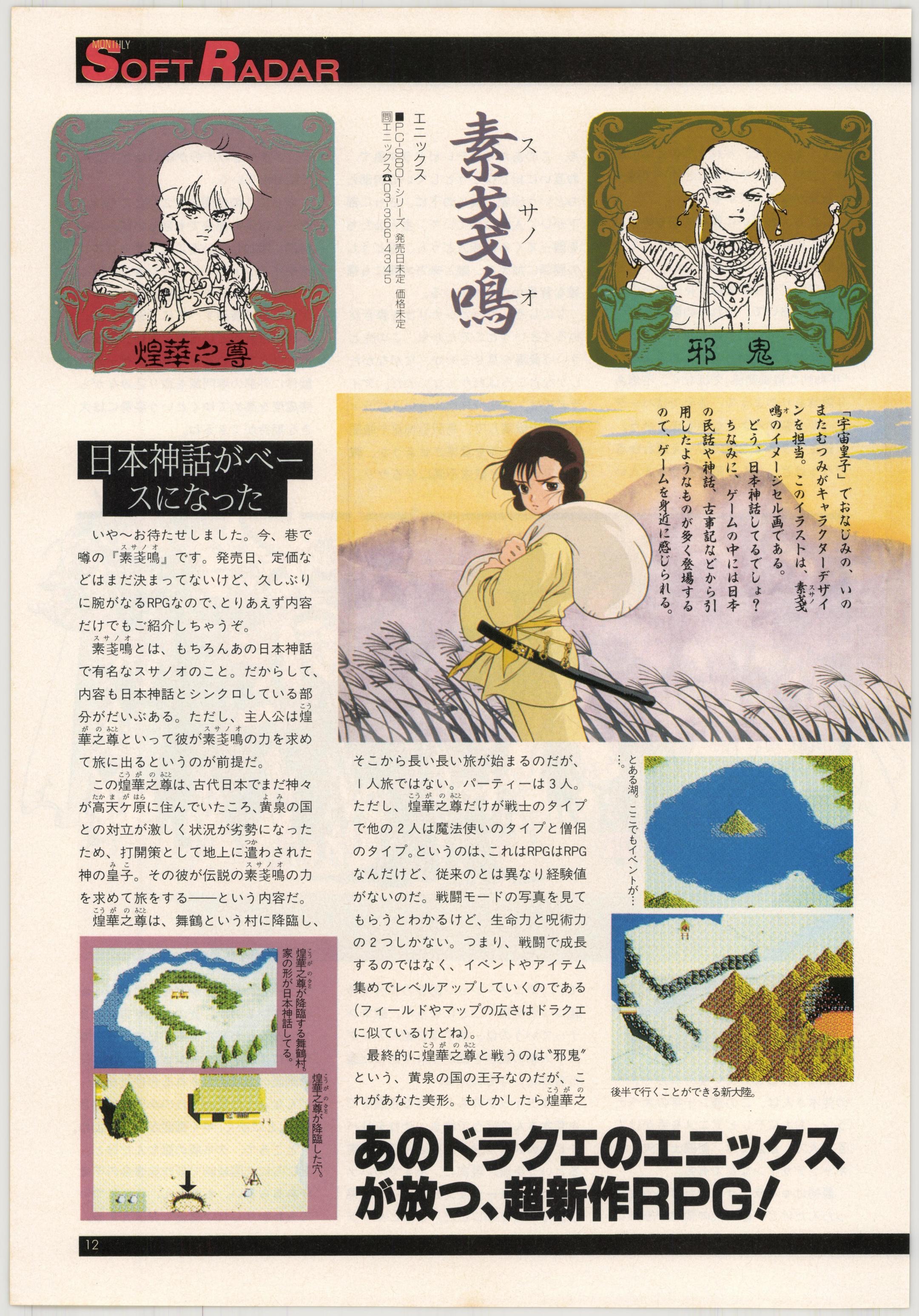
The main character is not simply the god Susanoo repeating his traditional story. The July dossier introduces Kōga no Mikoto, 煌華の尊, a young prince of Takamagahara, the heavenly domain of the gods. When Yomi’s forces invade his realm, he must leave it and descend to earth. His adventure involves seeking Susanoo’s legendary power so that he can confront this threat.

Susanoo — document from the collection 06
Document 06 · Enlarge ↗

This distinction explains the project’s title: Susanoo is the power being sought, whereas Kōga is the hero whose journey the player follows. The story draws on names and references from Japanese mythology but rearranges them around the game’s own conflict and characters. The May presentation already mentions the weakening of the gods’ power and the need to recover a sealed force to restore peace.

Opposing Kōga is Jaki, 邪鬼, introduced as the prince of Yomi. The published drawings contrast the young hero with this unsettling, elegant and threatening figure. They are more than decorative silhouettes: the press places them at the centre of the confrontation between the two realms. The surviving documents do not, however, reveal a complete ending or every twist in the scenario.

Comptiq · 1989-05 · pp. 72–73 ; Comptiq · 1989-07 · pp. 90–93 ; POPCOM · 1989-08 · pp. 12–13
Susanoo · 1989

A serious adventure with moments of humour

Susanoo — document from the collection 07
Document 07 · Enlarge ↗

The invasion of Takamagahara and the search for divine power give the adventure a dramatic foundation. Yet journalists do not describe a uniformly solemn story. The May presentation outlines a changing tone: lighter situations at the beginning, a darker middle section and a conclusion intended to move the player. This is the announced intention for the scenario, not a review of a finished commercial game.

Susanoo — document from the collection 08
Document 08 · Enlarge ↗

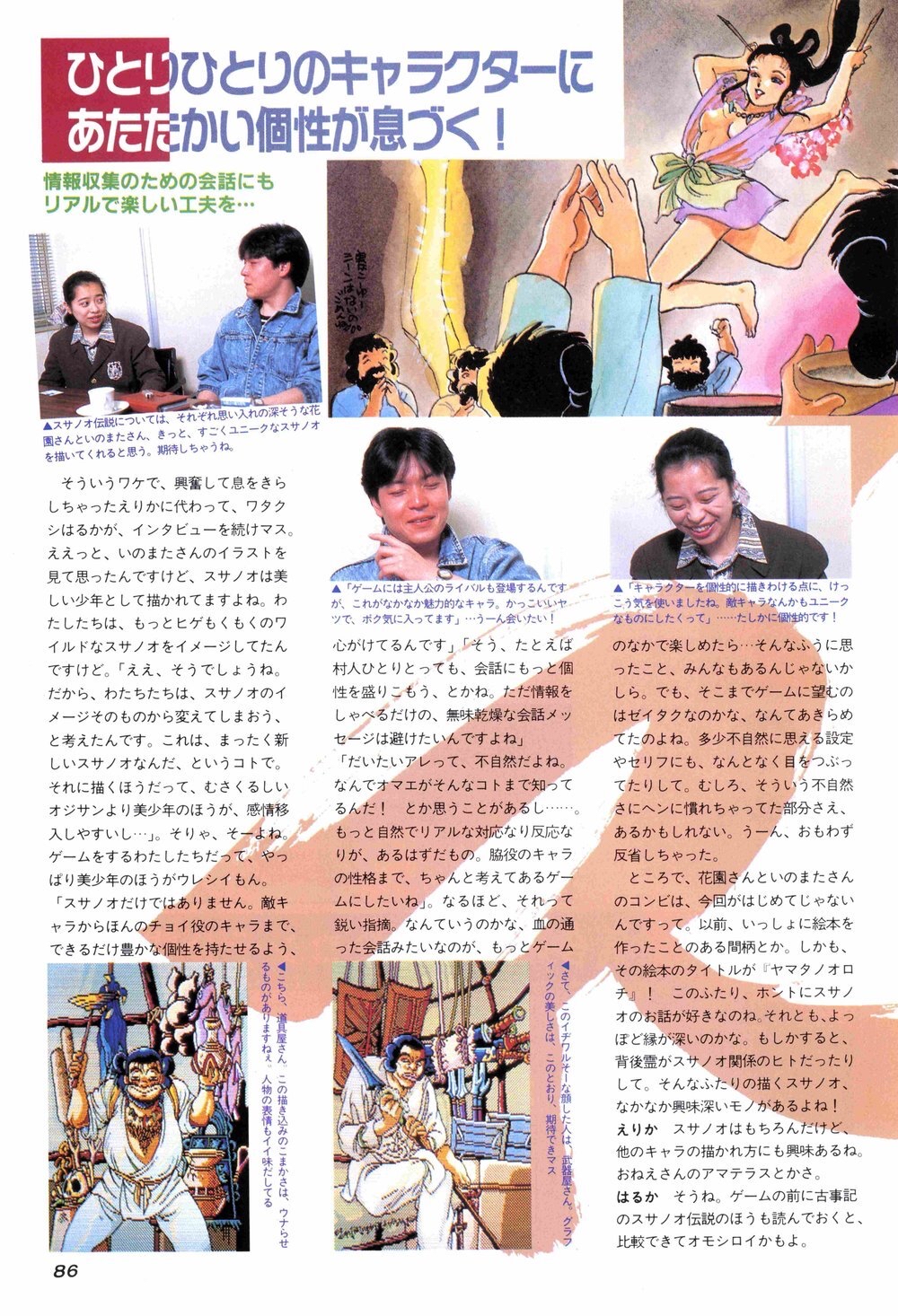
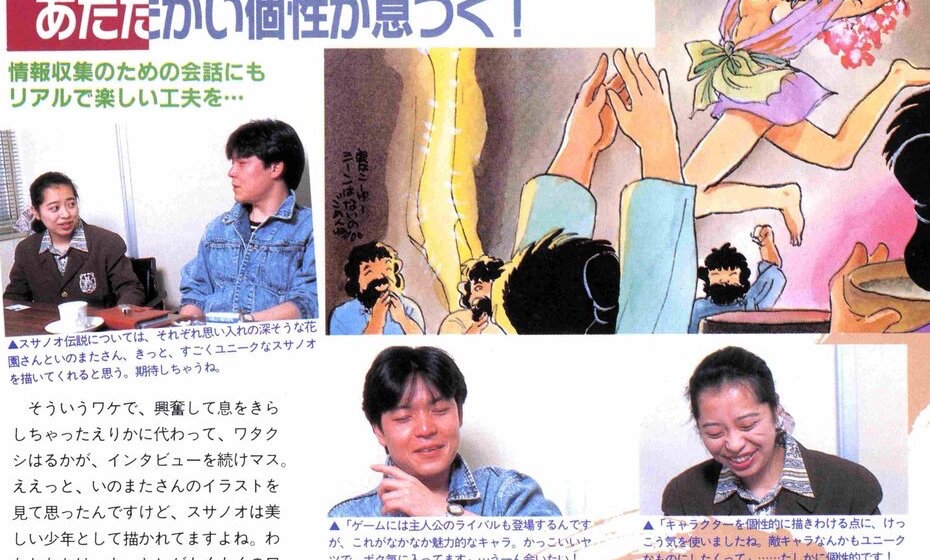
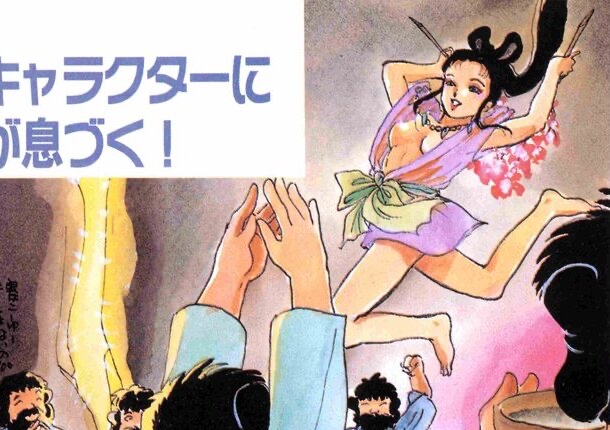
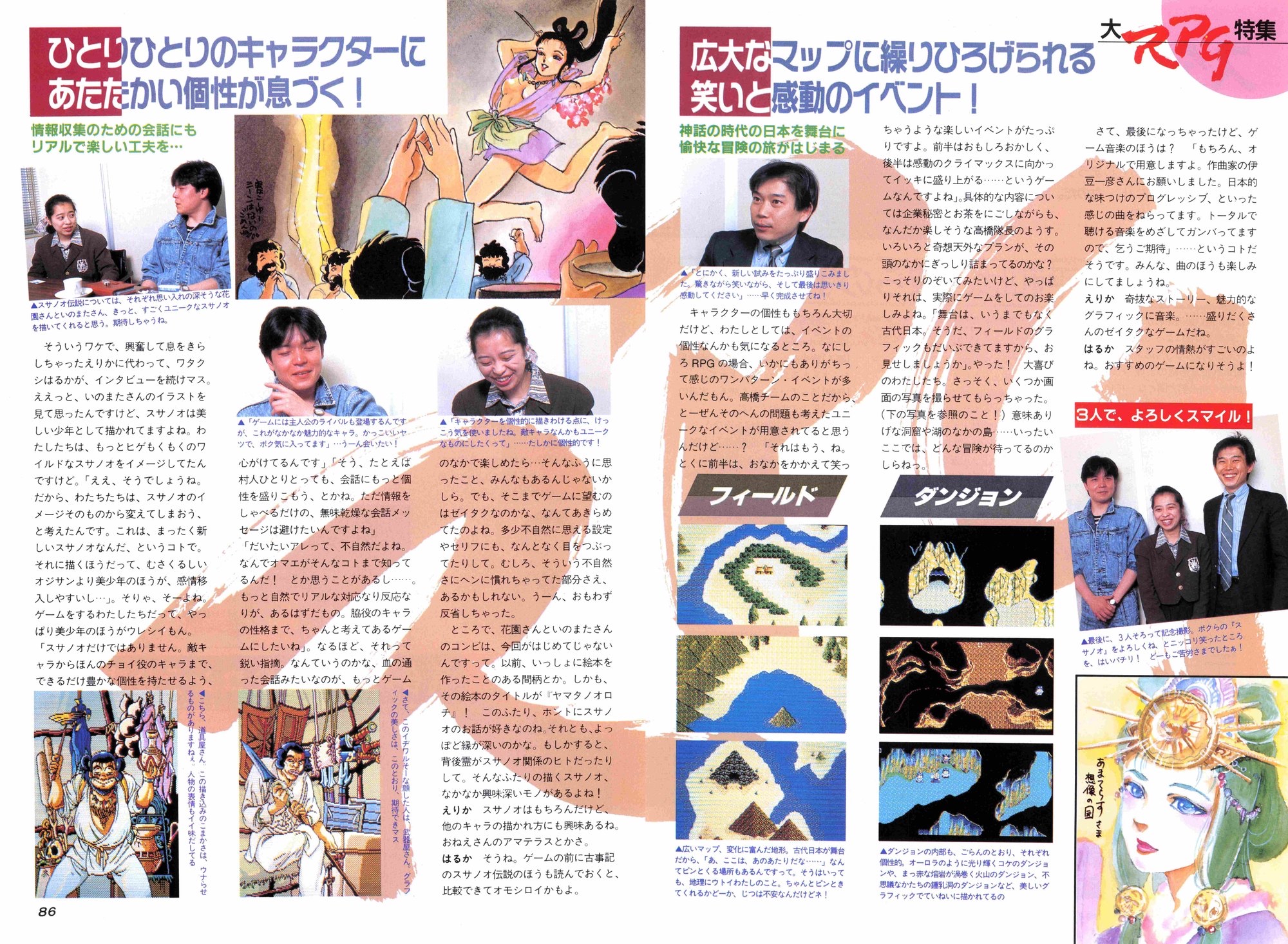
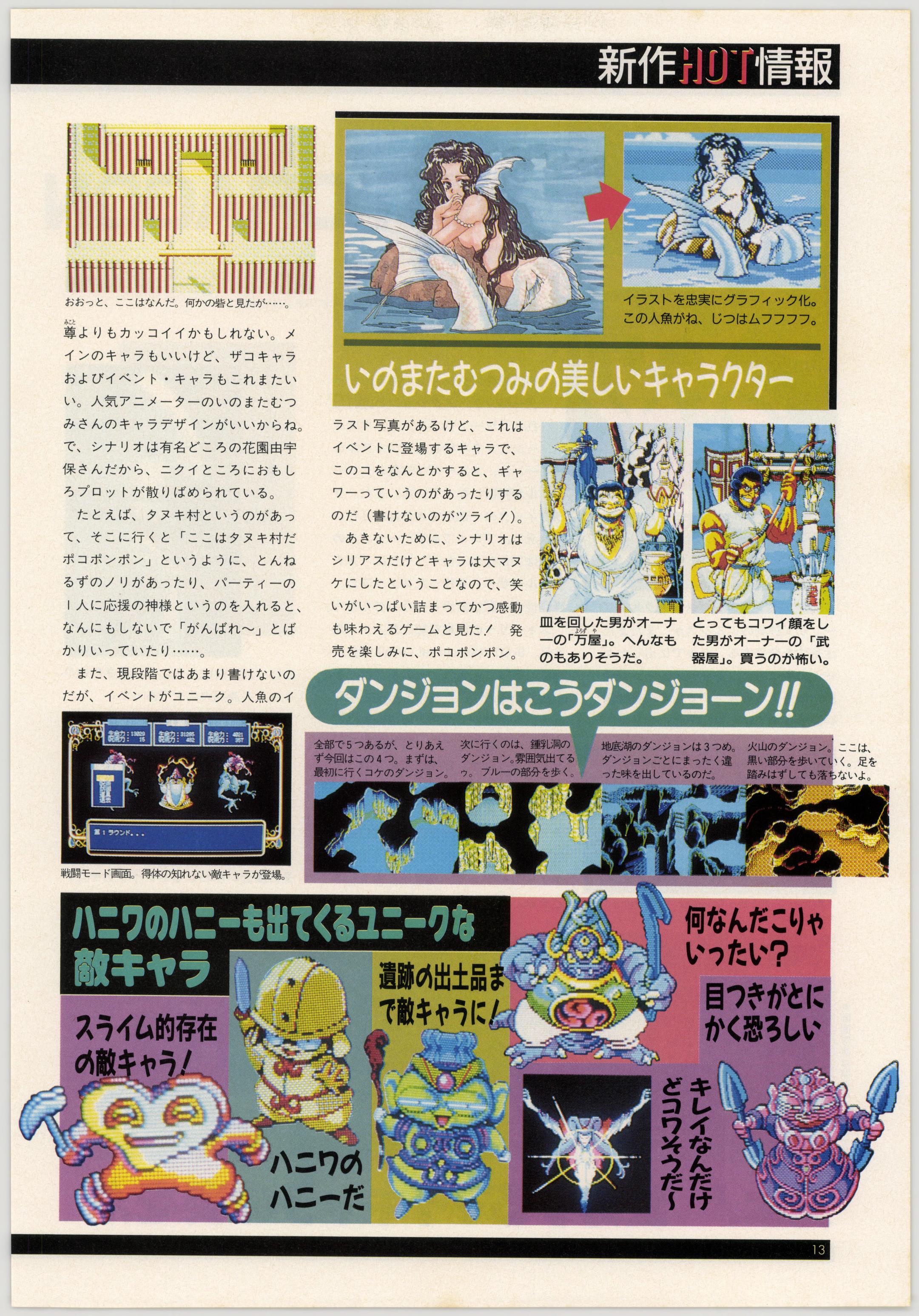
The published examples suggest this balance. POPCOM mentions a village of tanuki, while Comptiq introduces a deity whose main function is to encourage the group. This companion provides comic relief rather than spectacular offensive power. Merchants also contribute to the atmosphere: an imposing weapons dealer and a curiosities seller spinning a plate appear among the illustrated characters.

These details show that the research covers more than a major mythological conflict. The project also includes everyday life, unusual encounters and humorous pauses. The coexistence of the story’s stakes and the smaller scenes encountered during the journey gives the magazine presentations their distinctive world.

Comptiq · 1989-05 · pp. 72–73 ; Comptiq · 1989-07 · pp. 90–93 ; POPCOM · 1989-08 · pp. 12–13
Susanoo · 1989

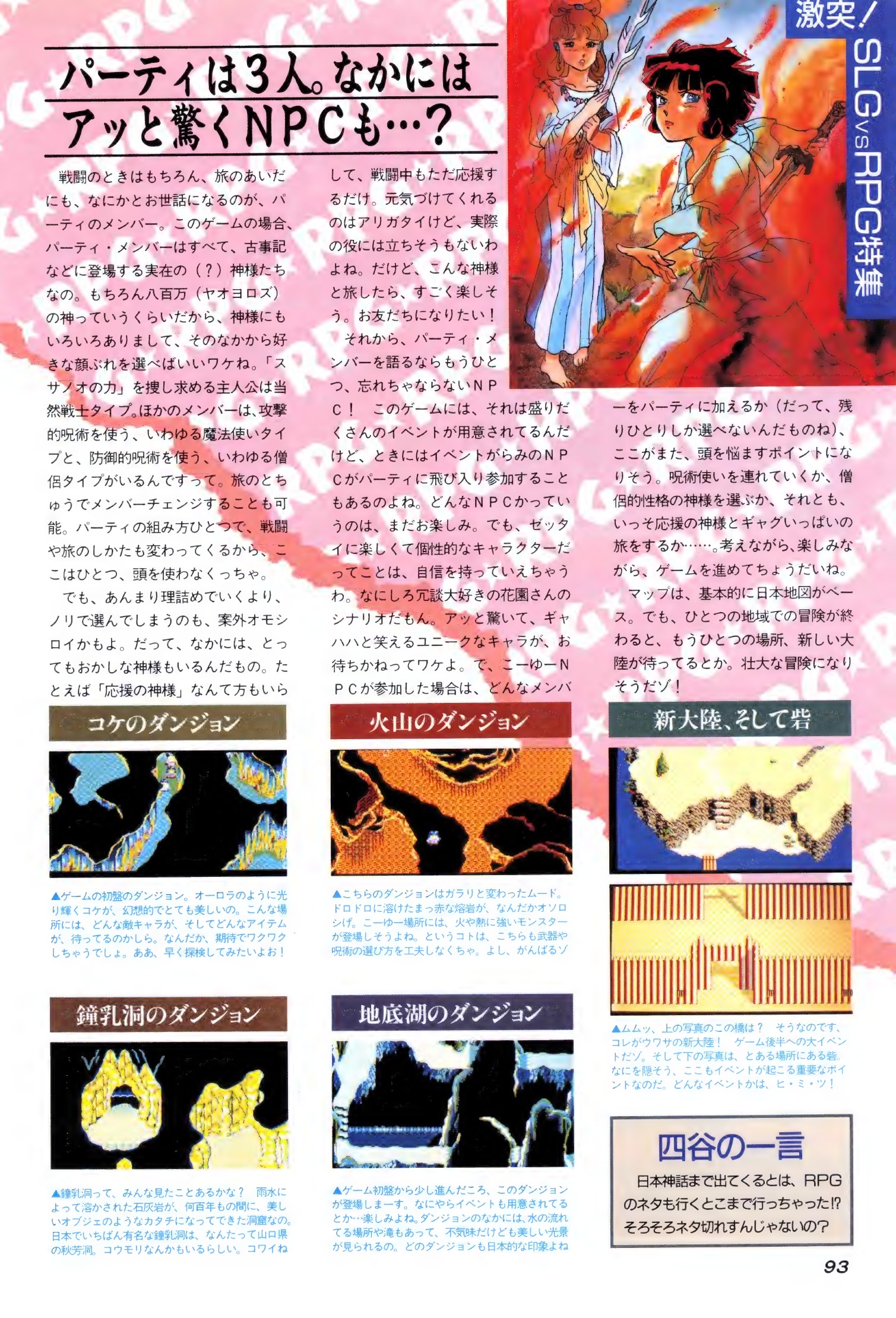
Three characters and changing companions

Susanoo — document from the collection 09
Document 09 · Enlarge ↗

The party consists of three characters. Kōga’s companions can change during the journey. Comptiq connects several encounters to deities from the Kojiki and distinguishes, among others, characters oriented towards offensive powers or protection. The party is therefore not presented as a trio permanently fixed at the beginning.

Susanoo — document from the collection 10
Document 10 · Enlarge ↗

Some characters encountered during events can join the team. Because places are limited, these arrivals require choices about who will accompany the hero. This structure links scenario encounters to party composition: travelling to a new region may change combat possibilities and the characters present in the adventure.

The encouraging deity also shows that party members are not defined solely by statistics. The descriptions give them roles, personalities and sometimes deliberately unconventional usefulness. The articles establish this principle of changing companions but do not allow a complete recruitment list or every joining condition to be reconstructed.

Comptiq · 1989-07 · pp. 90–93 ; POPCOM · 1989-08 · pp. 12–13
Susanoo · 1989

Weapons, ritual powers and command-based battles

Susanoo — document from the collection 11
Document 11 · Enlarge ↗

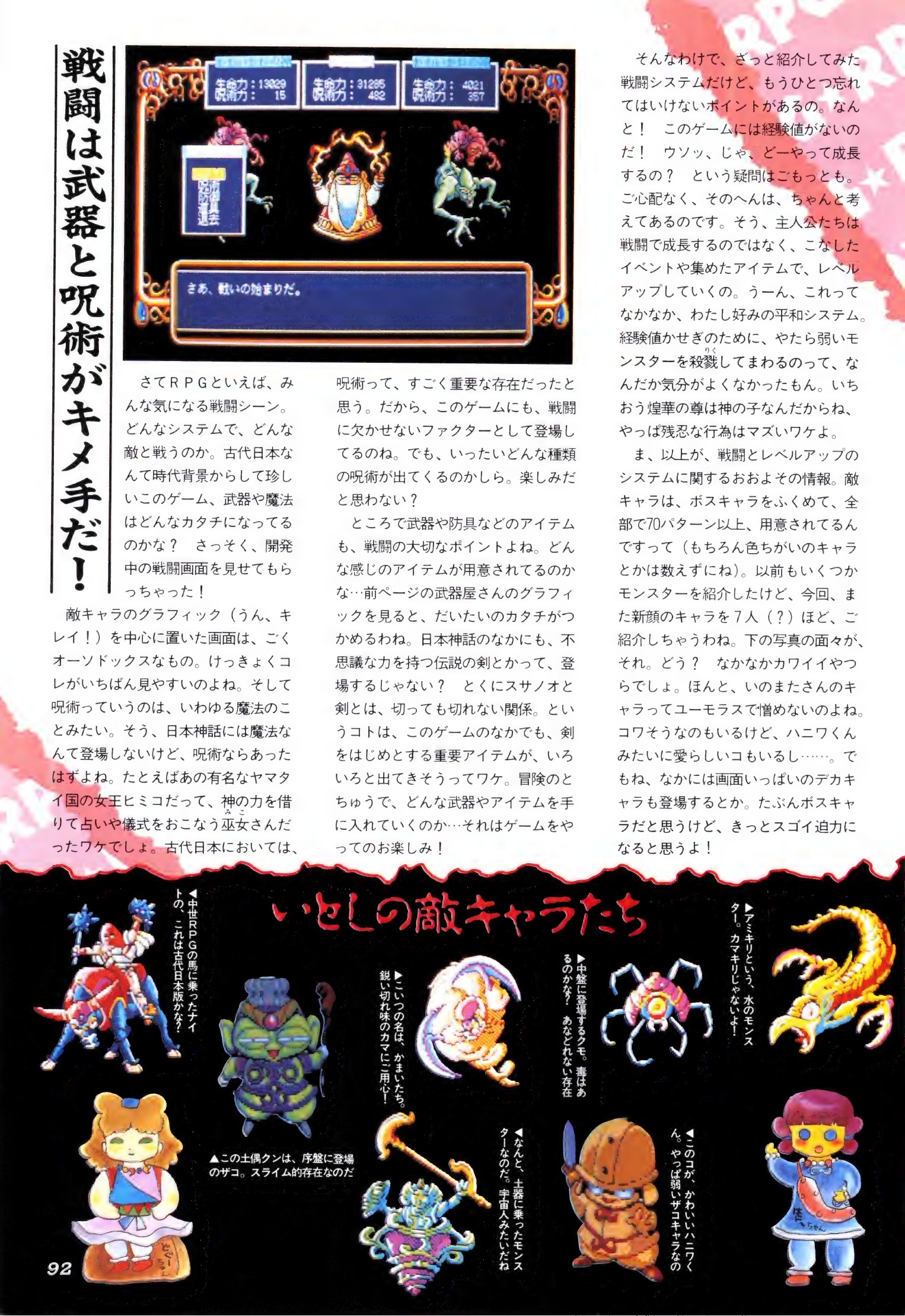
Battle screenshots show enemies facing the player and a command interface. The May presentation compares this structure to the kind of combat popularised by Dragon Quest. July’s articles explain weapons and powers called 呪術: supernatural or ritual techniques that contribute to the game’s mythological identity.

Susanoo — document from the collection 12
Document 12 · Enlarge ↗

Two resources appear in the explanations and screens: life force, 生命力, and ritual power, 呪術力. Companions’ profiles and equipment are intended to influence the player’s choices. Environments are not entirely separate from these decisions: the volcanic dungeon’s presentation mentions adapting equipment and techniques to the enemies found there.

Susanoo — document from the collection 13
Document 13 · Enlarge ↗

The images therefore document a specific interface and combat principles. They do not establish damage formulas, the precise order of turns or every technique’s effects. Those detailed rules would require additional documentation or a copy of the program, neither of which is provided by the sources assembled here.

Comptiq · 1989-05 · pp. 72–73 ; Comptiq · 1989-07 · pp. 90–93 ; POPCOM · 1989-08 · pp. 12–13
Susanoo · 1989

Progress without collecting experience points

Susanoo — document from the collection 14
Document 14 · Enlarge ↗

One of the project’s clearest characteristics is the absence of experience points. Comptiq states this explicitly, and POPCOM repeats it. Progress depends on adventure events and acquired items, rather than accumulating battles to increase an experience counter.

Susanoo — document from the collection 15
Document 15 · Enlarge ↗

This changes how the journey is presented. Exploration, encounters and acquisitions become stages of progression: advancing the story and finding necessary elements matter more than repeating the same fights. It does not mean battles disappear, as the magazines provide detailed screenshots and explanations of them.

The distinction must be preserved: the sources establish the absence of experience points and the importance of events and items. They do not reveal a complete levelling system or demonstrate that every battle is optional. The mechanism’s historical interest is substantial without adding undocumented rules.

Comptiq · 1989-07 · pp. 90–93 ; POPCOM · 1989-08 · pp. 12–13
Susanoo · 1989

From ancient villages to a new continent

Susanoo — document from the collection 16
Document 16 · Enlarge ↗

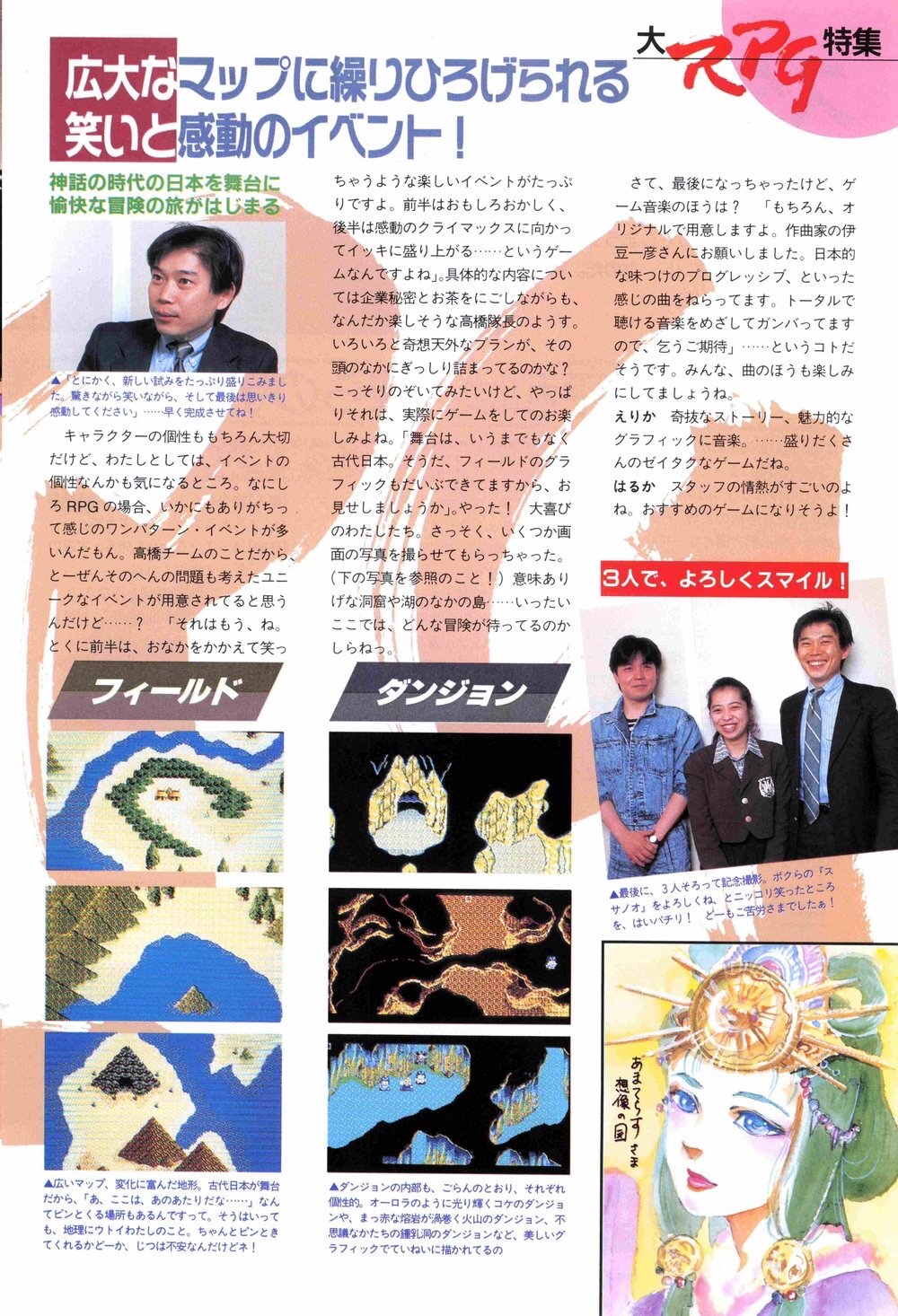
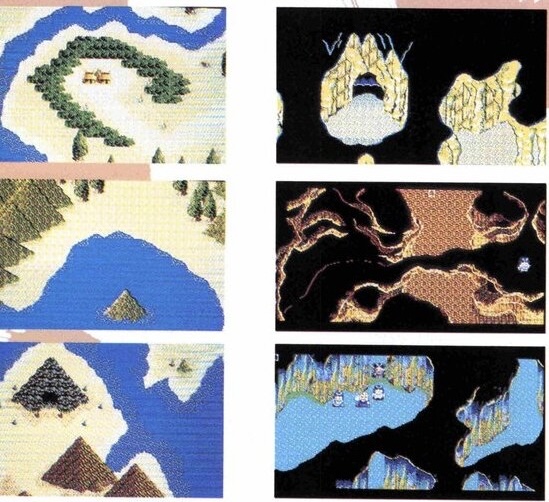
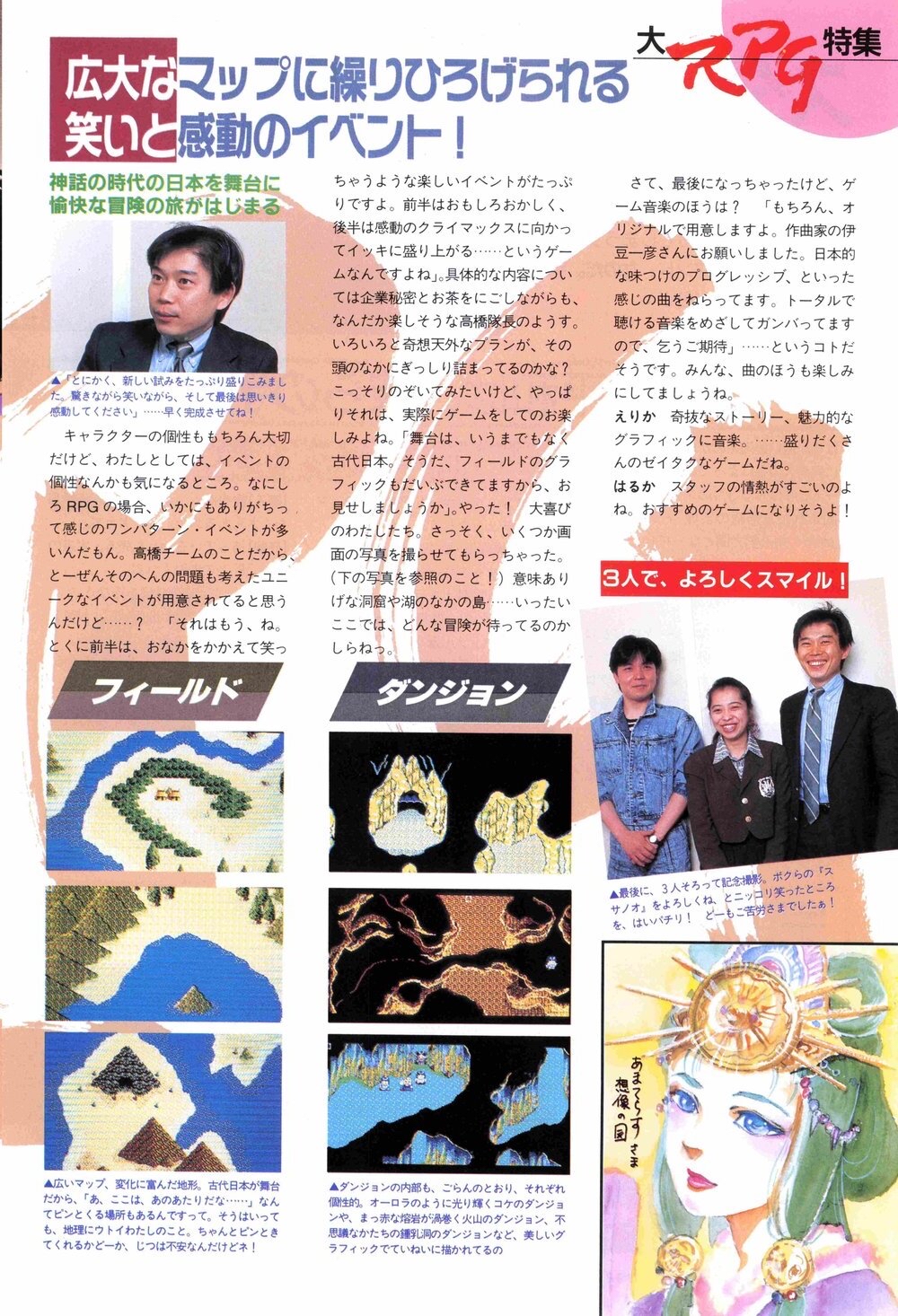
The initial geography draws on Japan before the adventure leads to a new continent. The July dossier shows cliffs, a bridge and an enclosed rocky area associated with an important event in the second half. These images indicate an expansion of the journey but do not supply the names or order of every region.

Susanoo — document from the collection 17
Document 17 · Enlarge ↗

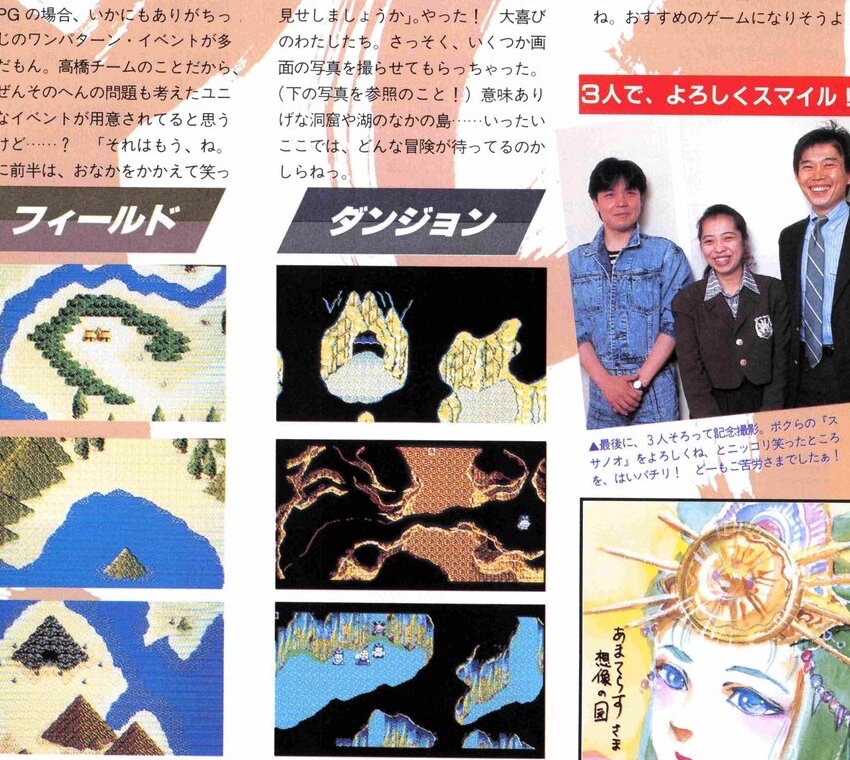
POPCOM shows the hero arriving in Maizuru village, 舞鶴. Its houses and layout evoke ancient Japan, with buildings unlike the medieval towns familiar from Western RPGs. May’s presentation also places a village illustration beside its screen representation, allowing a comparison between an environment concept and a game map.

The documents also show a lake with an island and locations intended for events. Landscapes therefore organise the scenario’s stages, encounters and movements. This relationship between geography and illustration is particularly important for Arita’s testimony: when he speaks of maps, he means the game’s maps and environments, not trading cards.

Comptiq · 1989-05 · pp. 72–73 ; Comptiq · 1989-07 · pp. 90–93 ; POPCOM · 1989-08 · pp. 12–13
Susanoo · 1989

Five dungeons announced, four settings shown

Susanoo — document from the collection 18
Document 18 · Enlarge ↗

POPCOM announces five dungeons and shows four types. The distinction matters: the four visible environments do not necessarily constitute the full planned inventory. The fifth cannot be described from these pages alone.

Susanoo — document from the collection 19
Document 19 · Enlarge ↗

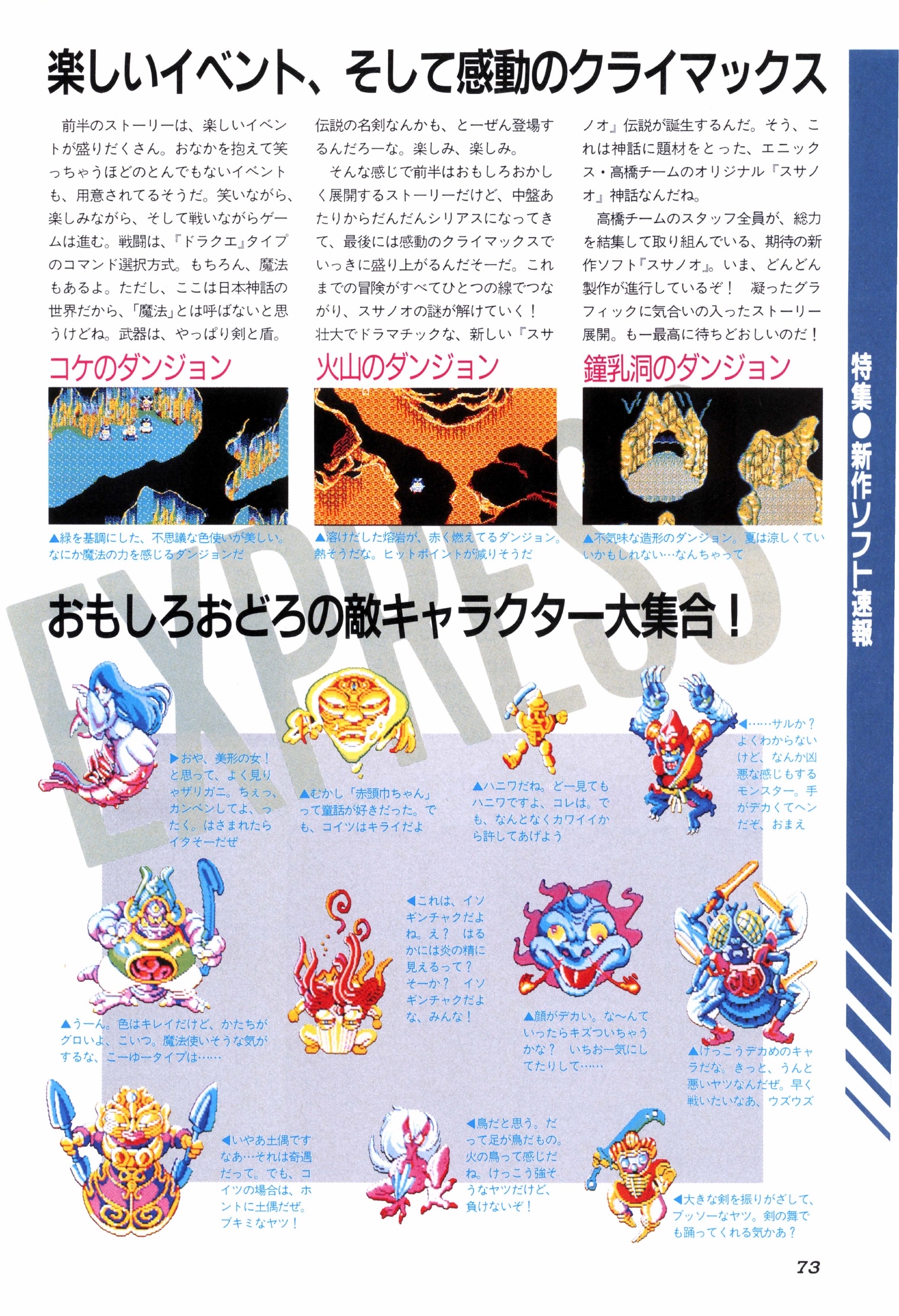
The moss cave stands out through luminous, almost aurora-like colours. The limestone cave emphasises rock formations and stalactites. The underground lake contrasts water with dark walls and changes in terrain height. Finally, the volcano uses lava reds and a hostile environment whose exploration is linked to equipment and power choices.

These places convey the art direction more concretely than the phrase ‘a game inspired by Japanese mythology’. They show a search for varied atmospheres, relief and colour contrasts. Here illustrations and screenshots explain the spaces traversed, extending beyond portraits of the main characters.

Comptiq · 1989-07 · pp. 90–93 ; POPCOM · 1989-08 · pp. 12–13

Susanoo · 1989

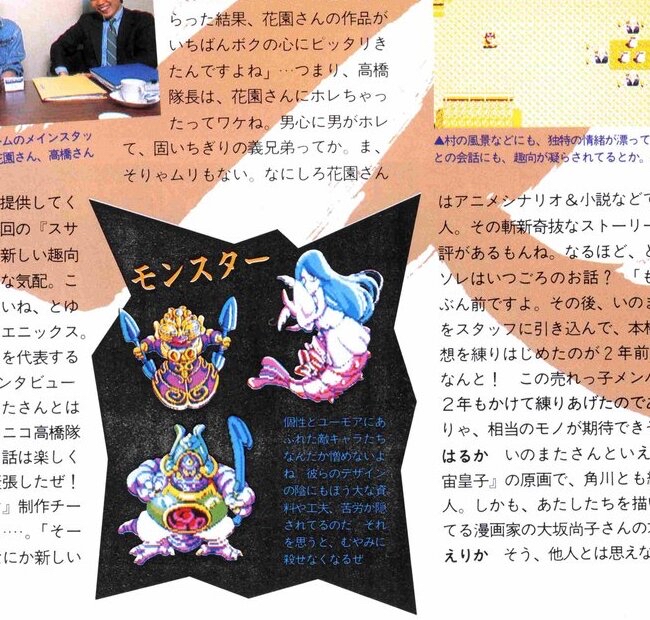
More than seventy enemy types announced

Susanoo — document from the collection 20
Document 20 · Enlarge ↗

Comptiq announces more than seventy enemy types, including bosses and excluding simple colour variations. This number describes content presented by the press during development; it does not prove that a definitive version containing all these enemies was completed.

Susanoo — document from the collection 21
Document 21 · Enlarge ↗

Illustrated creatures include opponents inspired by dogū, prehistoric clay figurines, and haniwa, associated with ancient Japanese tombs. The pages also show animal and supernatural creatures. The bestiary extends the world’s references: mythology and archaeology are not confined to the story or environments.

Susanoo — document from the collection 22
Document 22 · Enlarge ↗

Preparatory drawings and screen representations show how these forms become combat graphics. Some enemies have an imposing presence, while others retain a strange or humorous quality. The documents provide examples of this diversity without establishing a complete catalogue of names, statistics and encounters.

Comptiq · 1989-07 · pp. 90–93 ; POPCOM · 1989-08 · pp. 12–13

Susanoo · 1989

Mutsumi Inomata: from drawings to game graphics

Susanoo — document from the collection 23
Document 23 · Enlarge ↗

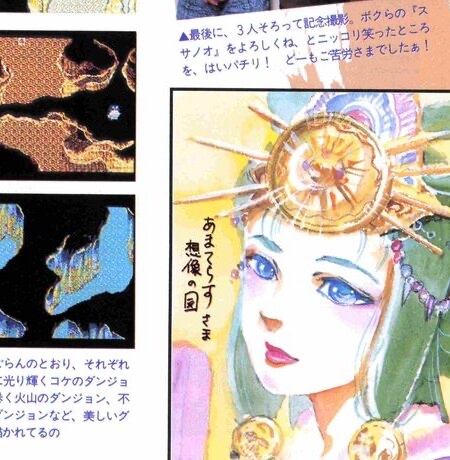
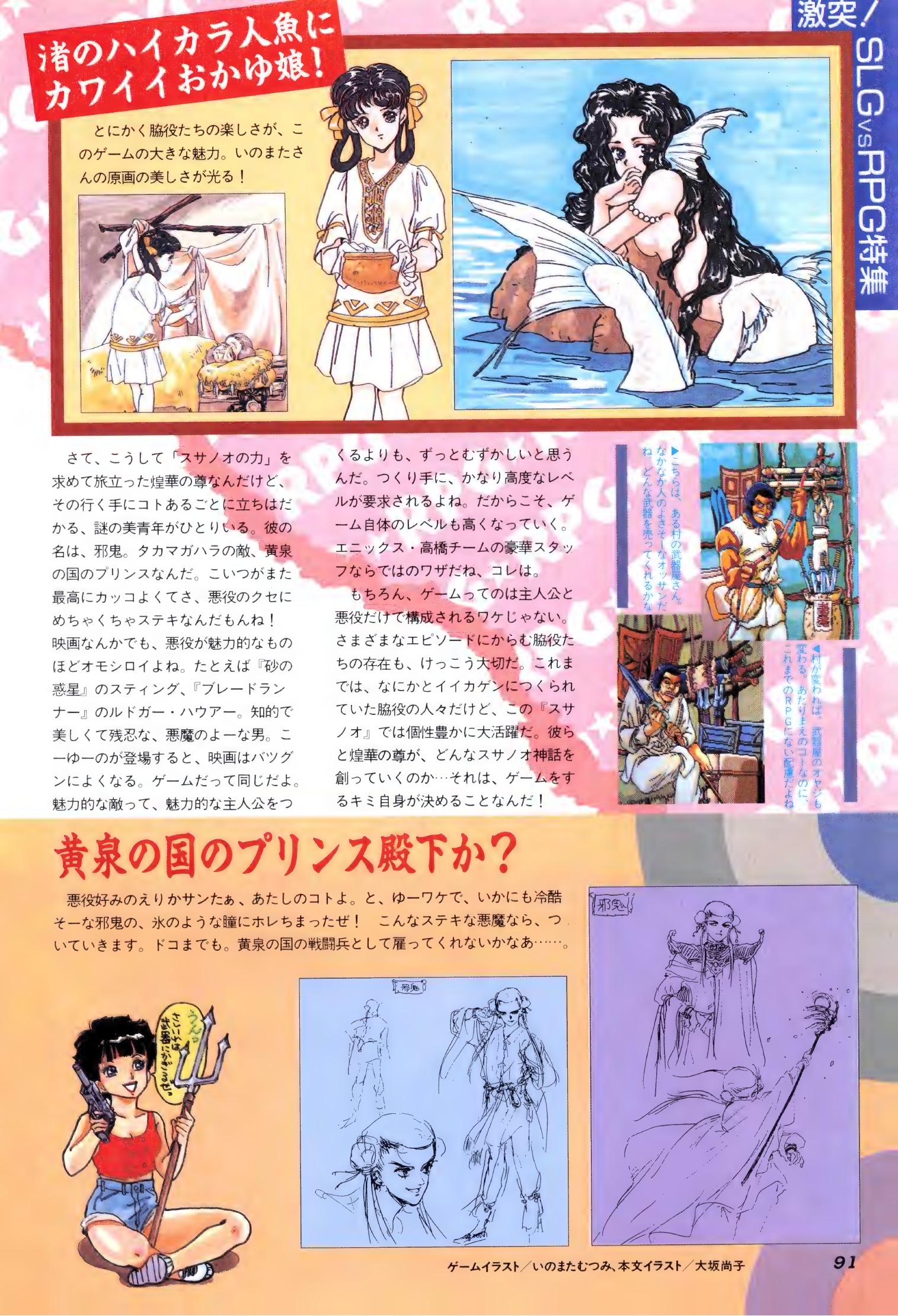
Mutsumi Inomata occupies a central place in Susanoo’s presentation. Arita identifies her as responsible for character design and the artwork overall. The magazines foreground her characters: Kōga, Jaki and supporting figures whose silhouettes and expressions give the project a recognisable identity.

Susanoo — document from the collection 24
Document 24 · Enlarge ↗

POPCOM provides a particularly useful example with a mermaid: the preparatory drawing and its pixel representation are published together. This comparison shows how a pose, silhouette and character elements are preserved when an illustration becomes a usable game graphic. It documents graphical adaptation without implying that one person carried out every stage.

Game images must also be distinguished from illustrations supplied by the magazines. Comptiq explicitly separates the credits for game illustrations from those for its article. Similarly, a village illustration published in May is associated with an animation background artist without being identified as Arita’s work. Its proximity to his testimony does not justify attributing every dossier image to him.

Comptiq · 1989-05 · pp. 72–73 ; Comptiq · 1989-07 · pp. 90–93 ; POPCOM · 1989-08 · pp. 12–13 ; Mitsuhiro Arita’s testimony preserved in the site’s research
Susanoo · 1989

Arita’s role: maps, characters and an editor

Susanoo — document from the collection 25
Document 25 · Enlarge ↗

Mitsuhiro Arita’s involvement should not be reduced to a name associated with the project. In his testimony he describes work on maps and characters, including development of an editor. He also explains that he was paid for atmospheric illustrations intended for maps, as Mutsumi Inomata’s assistant.

Susanoo — document from the collection 26
Document 26 · Enlarge ↗

This account links two aspects of his activity: building tools and creating images. Developing an editor belongs to the technical side, while atmospheric illustrations help prepare environments visually. These details are more precise than the general label ‘game illustrator’ and deserve to be preserved together.

His testimony supplies no exhaustive list of his images, number of environments or detailed editor description. Nor does it identify his hand throughout the magazine pages. His contribution is attested by his own words; individual attribution of documents must remain limited to images whose authorship can be established.

Mitsuhiro Arita’s testimony preserved in the site’s research

Mitsuhiro Arita · In his own words

When I worked on maps and characters for the game ‘Susanoo’, planned by Enix (including the development of an editor), I was paid to draw, among other things, image illustrations for the maps, as an assistant to Mutsumi Inomata, who was responsible for the character design and the artwork overall.

Translation of the Japanese testimony
Japanese original

エニックスが企画した「スサノオ」というゲームに、マップとキャラクター(エディタ開発含む)で参加した際、キャラクターデザインとアート全般を担当するいのまたむつみ先生のアシスタントとしてマップのイメージイラストなどを描き報酬を頂きました。

Susanoo · 1989

An encounter that influenced his career

Susanoo — document from the collection 27
Document 27 · Enlarge ↗

Susanoo also appears in Arita’s account of his professional choice. He recalls telling a scenario writer he met during the work that he intended to become a software engineer. The writer replied that abandoning illustration would be a shame when he drew so well. Arita presents this exchange as a factor that later contributed to his decision to pursue illustration.

Susanoo — document from the collection 28
Document 28 · Enlarge ↗

The interview published by Journal du Japon in 2022 provides context consistent with this path: Arita discusses his early interest in computing, his studies and his first attempts at making games. His Susanoo testimony thus belongs to a period when programming and drawing were still two possible directions for his future.

This recollection should not be turned into a more precise scene than the evidence permits. The scenario writer who offered the advice is not named in this answer. Yūho Hanazono is credited with Susanoo’s scenario in the press, but that does not prove he spoke those words. What can be retained with certainty is the importance Arita assigns to the encounter.

Mitsuhiro Arita’s testimony preserved in the site’s research ; Nathan Boulant · Journal du Japon · 2022-01-16

I told a scenario writer I met while working on ‘Susanoo’ that I intended to become a software engineer. He replied, ‘That would be a shame, when you draw so well.’ That is what later led me to choose illustration.

Mitsuhiro Arita

Susanoo · 1989

A documented project, a game never released

Susanoo — document from the collection 29
Document 29 · Enlarge ↗

The research brings together substantial material: character illustrations, environment concepts, map and battle screenshots, system descriptions and information about collaborators. This shows that Susanoo progressed beyond a title announcement. It does not measure development completion or certify the existence of a fully playable finished version.

Susanoo — document from the collection 30
Document 30 · Enlarge ↗

Another trace appears in the release calendar in LOGIN’s issue dated 20 October 1989. Susanoo appears in an undated list under Enix, with machine and price marked as undecided. The page states that its information was current as of 20 September: it therefore documents the list at that date, rather than confirming active development on 20 October.

No commercial release has been identified in the sources assembled for this dossier. The exact date and reason for abandonment remain unknown. None of these documents demonstrates a change of title, transformation into another game or preservation of an accessible prototype. These unanswered questions are part of Susanoo’s history and should not be filled with speculation.

Comptiq · 1989-05 · pp. 72–73 ; Comptiq · 1989-07 · pp. 90–93 ; POPCOM · 1989-08 · pp. 12–13 ; LOGIN · 1989-10-20 · p. 33
Traces in the press

The project’s chronology

  1. May 1989

    The project takes shape in the press

    Comptiq presents the mythological world, the selected scenario, Inomata’s illustrations and screenshots. The specification announces the PC-9801; price and release date remain undecided.

  2. July 1989

    A detailed dossier on story and systems

    Four Comptiq pages describe Kōga, Jaki, the three-person party, the absence of experience points, ritual powers, the bestiary and environments.

  3. August 1989

    Further comparisons between drawings and pixels

    POPCOM shows Maizuru village, dungeons, supporting characters and a mermaid’s pixel adaptation. Five dungeons are announced, with four types illustrated.

  4. 20 September 1989

    An announcement still without a date

    This is the information cutoff for LOGIN’s page published in the 20 October issue. Susanoo remains listed under Enix without a date, with machine and price undecided.

  5. After the announcements

    A release that has not been found

    The assembled documents provide neither an identified commercial edition nor an explanatory cancellation announcement. They reconstruct the announced project but cannot date its abandonment precisely.

Identified contributions

The people behind Susanoo

Enix
Company behind the project.
Mutsumi Inomata — いのまたむつみ
Character design and artwork, according to Arita’s testimony.
Yūho Hanazono — 花園由宇保
Scenario, credited in Comptiq and POPCOM.
Mitsuhiro Arita — 有田満弘
Maps, characters, editor development and atmospheric map illustrations as Inomata’s assistant.
Takahashi — 高橋
Enix representative in the May presentation; first name and precise job title are not established.

Documentation

Sources for the dossier

References and contents of each source
  • Comptiq · 1989-05 · pp. 72–73

    Project presentation, scenario, drawings, village and initial screenshots.

  • Comptiq · 1989-07 · pp. 90–93

    Dossier on characters, battles, progression, companions and locations.

  • POPCOM · 1989-08 · pp. 12–13
    Village, dungeons, party and comparison of illustration with pixel graphics.

  • LOGIN · 1989-10-20 · p. 33

    Release calendar: information current as of 20 September 1989.

  • Mitsuhiro Arita’s testimony preserved in the site’s research

    Work on maps, characters and an editor; assistance to Inomata; advice from a scenario writer.

  • Nathan Boulant · Journal du Japon · 2022-01-16

    Interview with Mitsuhiro Arita: context of his interest in computing and game creation.

This dossier reconstructs the announced project, rather than a finished commercial game. The reasons for its abandonment, its precise date and the existence of a preserved prototype remain to be established. Images without verified individual credits are not automatically attributed to Arita.

The numbering of the thirty documents follows the collection’s files; it establishes neither publication order nor the artist of each illustration. Click an image to open the original.

Back to archive